 FR
 EN
 DE
 ES

PPE ON FORESTRY WORKSITES: WHAT DOES THE REGULATION SAY?
What protective equipment is required for safe forestry work?
Tree felling, delimbing, timber extraction, silvicultural operations… Forestry professionals face numerous hazards: falling branches, flying debris, noise, uneven terrain and cuts from chainsaws.
Personal protective equipment (PPE) plays an essential role in preventing these risks.
But which equipment is mandatory? Is Class 3 chainsaw protective clothing always required? What is the difference between Category III PPE and Class 3 protective clothing?
FRANCITAL helps you understand the regulatory requirements and select appropriate protection for forestry work.
1. CATEGORY III AND CLASS 3: TWO VERY DIFFERENT CONCEPTS
These terms are often confused, although they refer to different characteristics.
Category: the severity of the risks covered
European Regulation (EU) 2016/425 divides PPE into three categories according to the nature of the risks against which it is intended to protect.
| Category | Risks covered |
|---|---|
| I | Minimal risks |
| II | Risks other than those covered by Categories I and III |
| III | Risks that may cause very serious consequences, including death or irreversible damage to health |
Protective clothing against cuts from hand-held chainsaws is classified as Category III PPE.
Hearing protection against harmful noise also falls within Category III.
Class: a level of performance
The class indicates a performance level defined by a technical standard.
For example, chainsaw protective trousers complying with EN ISO 11393-2 are tested at different chain speeds.
| Class | Chain speed during testing |
|---|---|
| Class 1 | 20 m/s |
| Class 2 | 24 m/s |
| Class 3 | 28 m/s |
These speeds refer to standardised test conditions and do not guarantee absolute protection in real working situations.
Key point
Class 1 chainsaw protective trousers are Category III PPE, just like Class 3 trousers.
The category identifies the severity of the risk covered. The class indicates the performance level assessed according to the relevant standard.
Class 3 protection is therefore not systematically mandatory for all forestry operations. The appropriate protection level must be selected according to the risks and working conditions.
2. WHICH PPE IS MANDATORY ON A FORESTRY WORKSITE?
Basic protective equipment for workers
In France, the French Rural and Maritime Fishing Code specifies the equipment required on active forestry and silvicultural worksites.
Article R. 717-83 provides for three items:
A safety helmet to protect the head.
Safety shoes or boots suitable for the terrain.
A brightly coloured garment or accessory allowing other workers to see the wearer.
An exemption from wearing a helmet may apply to certain silvicultural operations when justified by the nature of the work.
These provisions apply to people working on active forestry sites.
French legal reference: Article R. 717-83 of the French Rural and Maritime Fishing Code.
Suggested illustration: the three basic PPE items required on a forestry worksite.
3. WHAT ABOUT CHAINSAW OPERATORS?
Additional protective equipment is required
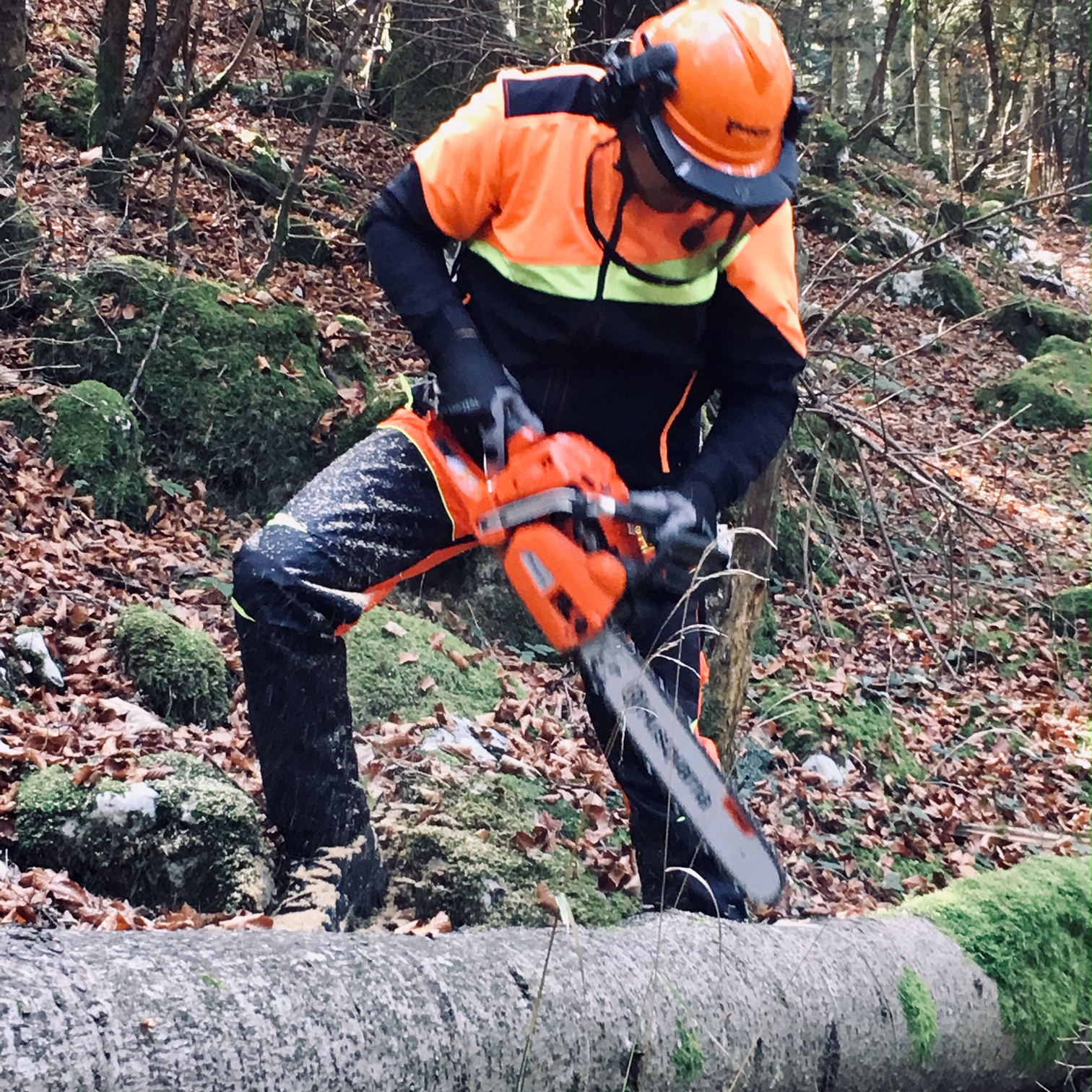
Using a hand-held chainsaw involves specific hazards, including cuts, flying debris and exposure to noise.
Article R. 717-83-1 provides for additional equipment:
Eye or face protection against flying debris: suitable safety glasses or a face shield.
Hearing protection against noise.
Protective gloves.
Chainsaw protective trousers or similar protective clothing, suitable for the cutting risks associated with the type of chainsaw used.
Safety footwear or boots offering chainsaw cut protection, appropriate for the equipment used.
These items complement the basic protective equipment required on forestry worksites.
French legal reference: Article R. 717-83-1 of the French Rural and Maritime Fishing Code.
Suggested illustration: complete PPE for a chainsaw operator.
PPE must be suitable for the risks
Selecting PPE involves more than simply checking that each item is present.
The level of protection, compatibility, fit and actual working conditions must also be considered.
Chainsaw protective trousers, for example, must be selected according to the tasks performed and the risk assessment.
Likewise, ordinary safety footwear is not necessarily suitable for chainsaw use.

4. WHAT ABOUT FORESTRY MACHINE OPERATORS?
Specific regulatory provisions apply to forestry machine operators.
Article R. 717-83-2 states in particular that operators must have gloves suitable for maintenance and servicing work available inside their cab.
A safety helmet and brightly coloured garment or accessory are required only when outside the cab.
Other protective equipment must be determined according to the tasks performed and the risks involved.
French legal reference: Article R. 717-83-2 of the French Rural and Maritime Fishing Code.
5. PPE NEVER GUARANTEES ABSOLUTE PROTECTION
Three essential safety principles
1. Do not confuse standardised performance with actual protection at the workplace.
PPE performance is assessed under test conditions defined by technical standards.
Real working conditions may be different.
2. No PPE protects against every risk in every situation.
Chainsaw protective clothing is designed to reduce the consequences of accidental contact with a moving chain, but cannot guarantee that injuries will be prevented.
3. PPE complements other preventive measures.
Training, worksite organisation, safe working techniques, machine maintenance and safe distances remain essential.
Effective protection combines safe working practices with properly selected equipment.
6. WHY IS CHAINSAW PROTECTIVE PPE CLASSIFIED AS CATEGORY III?
Stronger European regulatory requirements
Regulation (EU) 2016/425 included PPE protecting against cuts from hand-held chainsaws in Category III.
This category covers risks that may result in very serious consequences.
The regulation therefore requires a more stringent conformity assessment procedure.
What are the manufacturer's obligations?
For Category III PPE, the procedure includes:
EU type-examination (Module B)
A notified body examines the equipment's design and verifies compliance with the applicable requirements.
If the assessment is satisfactory, it issues an EU type-examination certificate, which is valid for a maximum of five years.
Monitoring of production conformity
The manufacturer must also apply one of the following procedures:
Module C2: supervised product checks at random intervals.
Module D: quality assurance of the production process.
These procedures help ensure that manufactured products remain consistent with the approved type.
7. FRANCITAL: PRODUCTION CONTROL UNDER MODULE D
Maintaining conformity throughout production
FRANCITAL ENVIRONNEMENT applies Module D, based on quality assurance of the production process, to the relevant Category III PPE.
This system involves regular surveillance of the quality management system by a notified body.
It complements the EU type-examinations carried out on the equipment.
This approach reflects our commitment to the reliability and conformity of our protective clothing.
Our objective: to develop and manufacture protective equipment whose certified performance is consistently maintained throughout production.
8. COMMUNICATION: AN ESSENTIAL PART OF WORKSITE SAFETY
Safety on forestry worksites does not depend solely on the protective equipment worn.
Workers must be able to communicate effectively, particularly in the event of an accident or dangerous situation.
Worksite organisation must include communication methods suited to the working conditions, especially to facilitate emergency alerts and rescue operations.
Hearing protection incorporating communication systems may be a suitable solution, provided it remains appropriate for the noise environment and the operators' needs.
Being protected also means being able to raise and receive an alert.
KEY POINTS TO REMEMBER
CATEGORY III — PPE designed to protect against risks that may have very serious consequences.
PROTECTION CLASS — A performance level assessed according to a technical standard.
FORESTRY WORKSITE — Safety helmet, safety shoes or boots and a brightly coloured garment or accessory, subject to specific regulatory provisions.
CHAINSAW USE — Additional protection for the eyes or face, hearing, hands, legs and feet.
PPE SELECTION — Always based on actual risks and working conditions.
SAFETY — PPE never replaces safe working practices.
To learn more, explore our PPE standards guide and our forestry PPE care recommendations.
FRANCITAL ENVIRONNEMENT — Textile expertise dedicated to your protection.
This guide presents the main French regulatory provisions applicable to PPE on forestry and silvicultural worksites. It does not replace a risk assessment, manufacturers' instructions or the full set of regulatory obligations applicable to each working situation.